Around her... Today.
Shuffled through many countries after her lonely aristocratic childhood during World War II, often left parentless for months in a row, M. had no clear definition of border, language or communication basics.
Being the child of the artist which she had firmly decided to become in Montreal's Automatist era was not necessarily an easy thing to accomplish, if only childhood in itself could for once be considered - even for an instant - as an accomplishment...
She used this status of 'being an artist' as a crutch for her inner missing pillars. In order to project herself into the world, she also needed to become a teacher.
As a result of this fragmented, distorted lifestyle, I am left today asking myself the following questions:
what is life with art? what is life without it?
where do we draw lines in our relationships to one another?
how do we break boundaries?
where is art, anyways?
is it in life, in our children, in our communities?
is it in the doing?
is it in the witnessing?
is it in the intention?
is it in the verb, the gesture, the act?
is it in the link, or is it in the transgression?
These questions (and many more) are her unintended legacy to me.
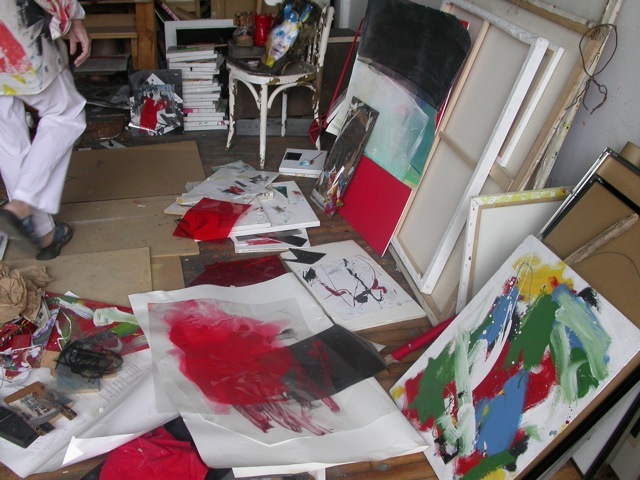
In this series of images taken in 2009 in her studio, I wondered if the viewer might think that the apparent mess comes from her being in the 7th year of her illness (dementia/alzheimer, it was never made clear, as she vividly refused herself to any diagnosis). I shall clarify rapidly. This is not the case. Her studio evolved along this same and very particular wavelength ever since she obtained access to one in 1971.
Inspired by the groove of abstract expressionism, she engaged in the process of art-making in such a way that there was no boundary between it and her everyday life. It all boiled down to one single laboratory - a process in which she would let her unconscious run freely, knowing no boundary or taboo.
She would bring the pains of life into her studio, and she brought the paints of her studio into her dwelling in a constant movement of exchange. She painted the walls of her bedroom in "womb red" in order to mark her private space within the household. She entertained a pathological rapport with both art, and life.
As a child, I subsequently ingested pigmented blue sugar from our family kitchen sugar bowl (that was "normality"), and witnessed her spilling coffee onto canvases "because she so enjoyed the texture or the grain of it".
She had no one to "pick up after her", nor to frame her doings and explorations, so I became the maid, the "clean-up person". I'm still cleaning up after her today, many years after parting with her quotidian... k
Shuffled through many countries after her lonely aristocratic childhood during World War II, often left parentless for months in a row, M. had no clear definition of border, language or communication basics.
Being the child of the artist which she had firmly decided to become in Montreal's Automatist era was not necessarily an easy thing to accomplish, if only childhood in itself could for once be considered - even for an instant - as an accomplishment...
She used this status of 'being an artist' as a crutch for her inner missing pillars. In order to project herself into the world, she also needed to become a teacher.
As a result of this fragmented, distorted lifestyle, I am left today asking myself the following questions:
what is life with art? what is life without it?
where do we draw lines in our relationships to one another?
how do we break boundaries?
where is art, anyways?
is it in life, in our children, in our communities?
is it in the doing?
is it in the witnessing?
is it in the intention?
is it in the verb, the gesture, the act?
is it in the link, or is it in the transgression?
These questions (and many more) are her unintended legacy to me.
In this series of images taken in 2009 in her studio, I wondered if the viewer might think that the apparent mess comes from her being in the 7th year of her illness (dementia/alzheimer, it was never made clear, as she vividly refused herself to any diagnosis). I shall clarify rapidly. This is not the case. Her studio evolved along this same and very particular wavelength ever since she obtained access to one in 1971.
Inspired by the groove of abstract expressionism, she engaged in the process of art-making in such a way that there was no boundary between it and her everyday life. It all boiled down to one single laboratory - a process in which she would let her unconscious run freely, knowing no boundary or taboo.
She would bring the pains of life into her studio, and she brought the paints of her studio into her dwelling in a constant movement of exchange. She painted the walls of her bedroom in "womb red" in order to mark her private space within the household. She entertained a pathological rapport with both art, and life.
As a child, I subsequently ingested pigmented blue sugar from our family kitchen sugar bowl (that was "normality"), and witnessed her spilling coffee onto canvases "because she so enjoyed the texture or the grain of it".
She had no one to "pick up after her", nor to frame her doings and explorations, so I became the maid, the "clean-up person". I'm still cleaning up after her today, many years after parting with her quotidian... k